English
  中文简体
中文简体 We are a national high-tech enterprise. At present, there are many kinds of self-woven and cooperatively processed fabrics, including microfiber warp-knitted towel cloth, weft-knitted towel cloth, coral fleece, etc.
Content
Thermodynamic Stability and Moisture Regain Comparison
- The primary reason strapworks polyester webbing remains the engineering benchmark for outdoor cargo management is its hydrophobic nature. Unlike Polyamide (Nylon), which has a moisture regain of 4.0% to 4.5%, Polyester (Polyethylene Terephthalate) maintains a regain of less than 0.4%. This prevents the polymer from swelling when exposed to rain or high humidity, ensuring that the breaking strength of polyester webbing remains constant in both wet and dry states.
- When evaluating polyester vs nylon webbing for outdoor tie-downs, engineers must account for the plasticizing effect of water. Nylon becomes more ductile and stretches significantly when wet, leading to loose cargo straps. Utilizing strapworks polyester webbing mitigates this risk by maintaining its original tension and dimensional integrity, regardless of environmental moisture ingress.
- The low elongation of polyester webbing is a critical performance metric for long-haul logistics. Under a static load of 2,500 lbs, polyester typically exhibits only 3% to 7% stretch, whereas nylon can exceed 20%. This minimal "creep" ensures that the tensile strength of strapworks polyester webbing is translated directly into load security without the need for constant re-tensioning.
UV Transmittance and Photo-Oxidative Degradation Resilience
- Long-term solar exposure is the leading cause of fiber failure in synthetic textiles. The UV resistance of polyester webbing is inherently superior to most industrial polymers due to the aromatic rings in its molecular backbone, which absorb and dissipate ultraviolet radiation more efficiently than the amide bonds in nylon. This is why polyester is preferred for permanent outdoor tie-downs in high-UV regions such as desert or alpine environments.
- After 500 hours of accelerated weathering testing according to ISO 105-B02, strapworks polyester webbing typically retains over 80% of its residual strength, while untreated nylon can lose up to 50%. For systems requiring heavy duty polyester webbing for cargo security, this longevity drastically reduces the replacement frequency and total lifecycle cost of the asset.
- To further enhance how to prevent webbing degradation from sunlight, high-performance variants incorporate specialized UV inhibitors during the melt-spinning process. This ensures that the longevity of strapworks polyester webbing is not merely a surface property but is integrated throughout the fiber cross-section, resisting the "chalking" and brittleness associated with long-term photo-oxidation.
Chemical Compatibility and Abrasion Resistance Metrics
- In industrial settings, chemical resistance of polyester vs nylon webbing is a vital selection criterion. Polyester shows exceptional stability when exposed to mineral acids and bleaching agents, making it the best material for industrial lifting and tie-down in chemical processing plants. Conversely, nylon degrades rapidly in acidic environments (pH less than 5.0), leading to catastrophic chain scission.
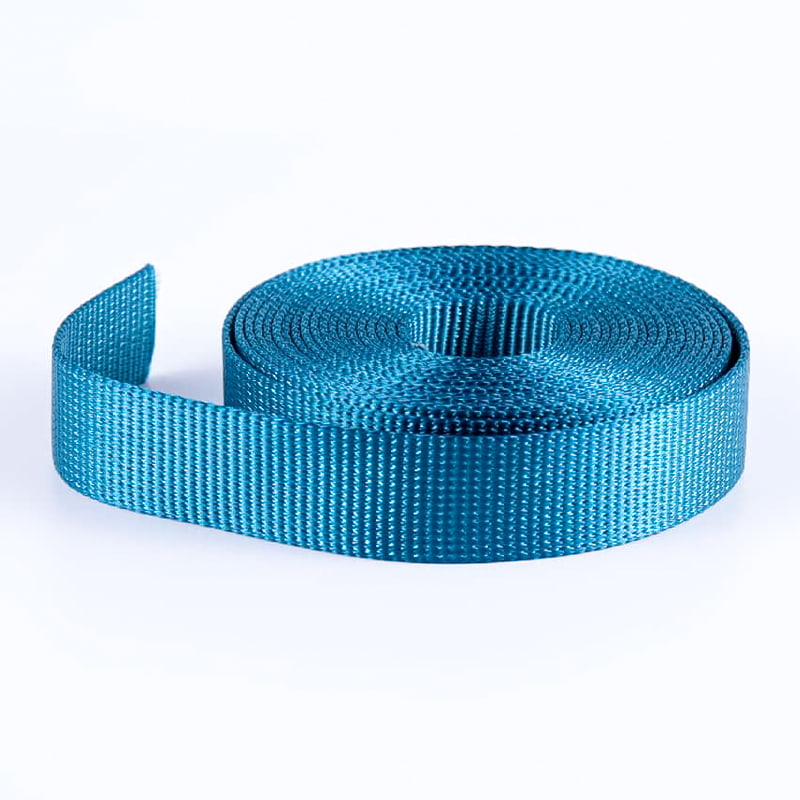
- The abrasion resistance of industrial polyester webbing is validated through the ASTM D6770 "Hex Bar" test. By utilizing a high-density "seatbelt" weave pattern, the surface friction is distributed across a larger contact area, preventing localized fiber fusion. This makes strapworks polyester webbing highly resistant to the scuffing and edge wear typical of securing cargo against rough wooden pallets or metallic frames.
- Technical Property Comparison Table:
| Mechanical Property | Standard Nylon 6.6 | Strapworks Polyester |
| Moisture Absorption (%) | 4.2% | 0.3% |
| Elongation at SWL (%) | > 10% | < 3% |
| Melting Point (Celsius) | 260°C | 255°C |
| Acid Resistance | Poor | Excellent |
Mechanical Interface and Load Handling Standards
- The safe working load for polyester webbing is established through a 3:1 or 5:1 safety factor, ensuring that the maximum tension applied during transport remains well below the elastic limit. Because of the low stretch of strapworks polyester webbing, it is the ideal substrate for ratchet straps, as it does not "bounce" during transit, which prevents dynamic shock loads from exceeding the breaking point of the hardware.
- To ensure quality control for industrial tie-down webbing, every production lot must undergo elongation-under-load verification. This ensures that the webbing meets the specific modulus of elasticity required for aerospace or automotive cargo restraint systems, where zero-slack performance is mandatory.
Engineering FAQ
- Will polyester webbing rot if left outside? No, polyester is highly resistant to rot, mildew, and microbial growth because it does not absorb the moisture necessary for these organisms to thrive.
- Does color fade indicate a loss of strength? While color fade is a sign of UV exposure, it is not a linear indicator of strength loss. However, it should trigger a professional inspection for fiber brittleness.
- Can I use polyester webbing for recovery/towing? For static towing, yes. For dynamic "snatch" recovery, nylon is better because its high stretch absorbs the kinetic energy of the moving vehicle.
- Is polyester webbing fireproof? No, it will melt at approximately 255°C. For fire-resistant applications, Aramid or specialized coatings are required.
- What is the typical lifespan of an outdoor polyester strap? In standard conditions, 3 to 5 years is common, though this can be extended with proper UV treatments and regular cleaning.
Technical References
- ASTM D6770: Standard Test Method for Abrasion Resistance of Textile Webbing (Hex Bar Method).
- WSTDA-T-1: Recommended Standard Specification for Synthetic Web Slings.
- ISO 105-B02: Textiles - Tests for colour fastness - Part B02: Colour fastness to artificial light.