English
 中文简体
We are a national high-tech enterprise. At present, there are many kinds of self-woven and cooperatively processed fabrics, including microfiber warp-knitted towel cloth, weft-knitted towel cloth, coral fleece, etc.
Content
- 1 Custom Pet Leash Webbing Begins as Four Numbers on a Spec Sheet
- 2 Width, Material and Weave Set the Breaking Load
- 3 Reflective Webbing: The Numbers Retail Buyers Ask For
- 4 Stitching and Hardware Fail Before the Webbing Does
- 5 Matching Custom Pet Leash Webbing to Dog Size and Lead Type
- 6 What to Put in an RFQ for Custom Pet Leash Webbing
- 7 FAQ: Ordering Custom Pet Leash Webbing
An 8,000-piece leash order comes back from a European retailer because the finished webbing measures 24.6 mm against a 25 mm drawing, the bar-tack pulls out of the handle under a 60 kg static load, and the reflective strip stops reading at 80 metres. None of that happened in the sewing room. All of it was decided weeks earlier, when the custom pet leash webbing was specified by width and colour alone.
This guide works through the numbers that decide whether a leash programme passes: finished width and its tolerance, warp density and yarn, minimum break load and elongation, colourfastness, retro-reflective grade, thread size and hardware rating. These are the figures that mills and retail buyers actually write into specifications and test protocols.
0.5 mm The width tolerance normally written into a leash webbing purchase order. A looser window shows up later as hardware that will not thread and a sewn edge that waves along the handle.
1.0-2.5 cm finished widths covering the large majority of leash programmes
300-620 kg typical minimum break load of 2.0 to 2.5 cm polyester leash tape
3-5% elongation of a polyester warp at working load
Custom Pet Leash Webbing Begins as Four Numbers on a Spec Sheet
Custom pet leash webbing is narrow woven fabric made to a leash brand's own width, yarn, weave, colour and performance specification, rather than pulled from a stock range of fixed colours. Four numbers control whether the finished lead passes: finished width, minimum break load, maximum elongation and colourfastness. A fifth, the retro-reflective value, is added whenever the lead has to stay visible after dark.
Width is measured on the finished, dyed roll, not on the loom. Dyeing and heat setting take 2 to 4 percent out of a greige tape, so a mill quoting 25 mm off the loom will hand over 24.2 mm at the packing table. Buyers who need a swivel snap to run cleanly through a stitched channel write the tolerance as plus or minus 0.5 mm and ask for a measurement every 500 metres.
| Finished width | Dog size | Common weave | Why buyers choose it |
| 1.0 cm | Toy and small breeds, under 8 kg | Flat weave, plain twill | Keeps grip leads and training tabs light, and takes a 6 to 8 mm reflective element |
| 1.5 cm | Small to medium, 8 to 15 kg | Twill, double-sided lockstitch | Softer edge where the hand grips on long walks |
| 2.0 cm | Medium, 15 to 30 kg | Flat, twill, fluorescent | The volume band in most retail leash programmes |
| 2.5 cm | Large, over 30 kg | Thickened flat, thickened twill | Spreads load across the chest strap and the handle |
Width on its own will not protect the order. A 2.5 cm tape woven at 700 warp ends per metre can test below a denser 2.0 cm tape, and that difference shows up in a pull test, never in a photograph.
Width, Material and Weave Set the Breaking Load
Break load is set by warp density and yarn denier as much as by width. A 2.0 cm polyester leash webbing woven at 1,100 ends per metre from 550 dtex yarn typically tests higher than a 2.5 cm tape with 700 ends, even though the wider tape looks heavier on the shelf.
Ask for the test method alongside the number: 300 mm gauge length, 25 mm per minute crosshead speed, five specimens, lowest value reported. Wet testing matters for leads sold into coastal markets, where a polyester tape can lose 5 to 8 percent of its dry break load after 24 hours of immersion, and UV ageing matters for leads that live on a balcony rail.
Material then sets the character of the lead. Polyester, nylon, polypropylene and cotton all weave into leash tape, but they behave differently under load, sunlight and washing, and the yarn lot has to be fixed before weaving if colour has to match a previous order exactly.
Polyester
The default for leash programmes: 3 to 5 percent elongation, good UV stability and colour holding at grade 4 or better. Dense enough at 1,100 ends per metre to push a 2.5 cm tape past 500 kg.
Nylon
Higher tensile strength and 8 to 12 percent elongation, which softens the jolt of a lunging dog. It fades faster in sunlight and costs more per metre.
Polypropylene
The lightest and cheapest option, and it floats. UV resistance is the weak point, so it suits indoor training leads and short-life programmes.
Cotton
A soft hand and a natural look for training leads, but the lowest break load of the four and 3 to 5 percent shrinkage after the first wash.
The gap between two suppliers quoting the same 2.5 cm specification usually comes down to warp density, dye lot control and inspection routine. A closer look at what makes high-quality pet leash webbing explains where that gap is created on the loom.
Reflective Webbing: The Numbers Retail Buyers Ask For
A reflective leash webbing earns its place on the shelf only when its retro-reflective value stays above 330 cd/lx/m2 after 25 home washes. Below that figure, the night-visibility claim will not survive a buyer's own test in a car park at 150 metres.
Two constructions dominate. Glass-bead coated tape is stitched or woven onto a base webbing, usually 6 to 8 mm wide on a 1.0 cm lead and offset from the seam so the needle never punches through the bead layer. Woven reflective yarn is built into the tape structure itself and cannot peel or crack, but it adds 20 to 30 percent to the metre price. On a 2.5 cm lead, keeping the reflective element at 2 cm leaves enough base colour visible on both edges for daytime recognition.
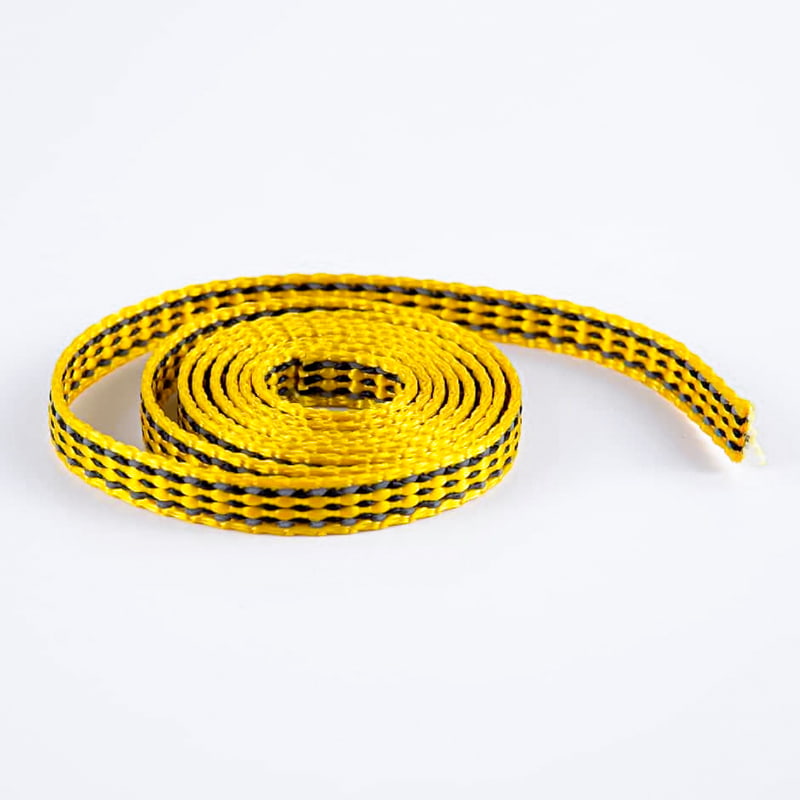 1.0 cm Reflective Polyester Webbing for Pet Training LeashesReflective polyester webbing in a 1.0 cm width for pet training leashes, designed for lightweight control and improved visibility in dim conditions.View Product →
330 cd/lx/m2 after 25 washes is the number that keeps a night-visibility claim standing.
Stitching and Hardware Fail Before the Webbing Does
In field returns, the webbing is rarely the part that broke. The bar-tack pulls out of the handle, the swivel snap deforms, or the seam unzips where the thread was one size too light for the load it carried.
- Box-X stitch with two bar-tacks at each end of the handle, 42 stitches or more per bar-tack on 2.0 to 2.5 cm webbing
- Bonded nylon thread, Tex 70 (size 69) on 1.0 to 1.5 cm webbing and Tex 90 (size 92) on 2.0 to 2.5 cm
- Stitch density of 8 to 10 stitches per inch; below 6 the seam sags and the webbing edge rolls
- Hardware rated at 1.5 times the webbing break load, so a 2.5 cm polyester lead takes a 340 kg (750 lb) swivel snap
- Needle size 18 to 20 with a round point, which pushes between warp yarns instead of cutting them
Thread is the cheapest component on a leash and the most common reason a container is rejected.
Matching Custom Pet Leash Webbing to Dog Size and Lead Type
Width follows the load a lead will actually see, not the way it looks on a shelf. A 1.0 cm tape built from dense polyester will outlast a loose 2.0 cm tape on a 6 kg terrier, and a soft 1.5 cm twill is easier on the hand than a stiff 2.5 cm flat tape on a 12 kg spaniel.
- Under 8 kg: 1.0 cm flat or twill, light hardware, reflective element for city walking
- 8 to 15 kg: 1.5 cm twill or double-sided lockstitch, with a soft edge where the hand grips
- 15 to 30 kg: 2.0 cm flat, twill or fluorescent, the volume band in retail programmes
- Over 30 kg: 2.5 cm thickened flat or thickened twill, wider handle, load spread across the chest
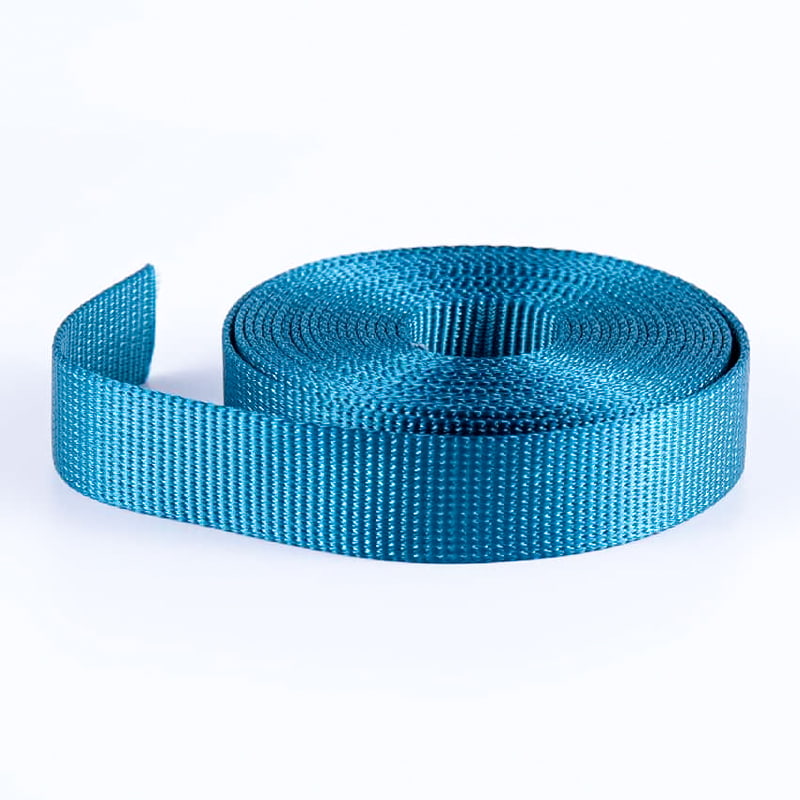 2.5 cm Thickened Polyester Webbing for Large Pet LeashesHeavy-duty 2.5 cm polyester webbing for large dog leashes and training, offering high tensile strength, abrasion resistance, and outdoor durability.View Product →
For running, bike or retractable leads, check elongation before width. A tape that stretches 10 percent under a lunging dog will feel loose in the handle on every walk, whatever the break load says.
What to Put in an RFQ for Custom Pet Leash Webbing
A request that lists width, colour and quantity returns a quotation. A request that adds break load, elongation, colourfastness, packing and inspection terms returns a shipment that clears the buyer's own test.
- Finished width in millimetres with an explicit tolerance, plus the greige width if the tape is dyed
- Material and yarn, for example 100 percent polyester, 550 dtex warp, 1,100 ends per metre
- Minimum break load and maximum elongation, with the test method and specimen count
- Weave and edge construction: flat, twill, double-sided lockstitch, hollow or mesh
- Colour reference as a Pantone TCX code plus a physical standard, with light and wash fastness at grade 4 or better
- Reflective grade if required, stated as an R value and a wash cycle count
- Packing and inspection: roll length, core diameter, carton count and an AQL 2.5 inspection before shipment
- Sampling and lead time expectations: 7 to 10 days for a counter sample, 25 to 30 days for 20,000 metres
Mills in Haining and the wider Zhejiang webbing cluster normally quote 3,000 to 5,000 metres per colour for a new warp, because a warp change costs a full shift. Brands that expect to reorder should lock the yarn lot at the sampling stage. Ordering from a factory rather than a trading company shortens that loop, and Haining Fengrun Rope Weaving Co., Ltd. weaves its own tape and works from customer samples, which is the model most leash brands look for.
Collar and lead sets are usually woven as one colour lot, so the collar tape belongs on the same order as the lead tape and should be specified at the same time.
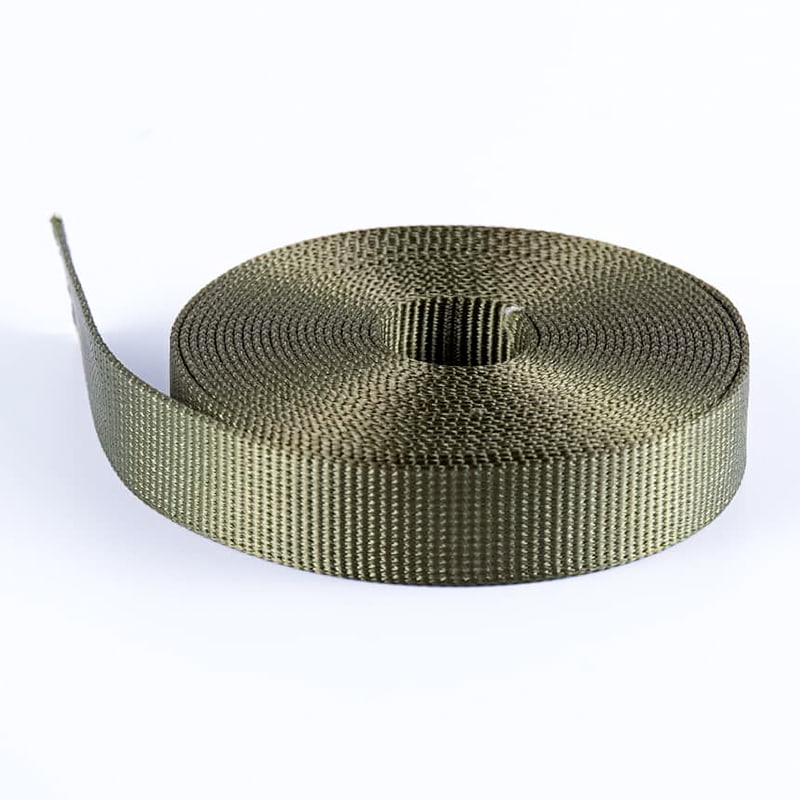 2.5 cm Polyester Twill Flexible Webbing for Dog CollarsFlexible 2.5 cm twill polyester webbing for dog collars and leads, with antibacterial treatment and ultrasonic sealed edges for comfort and durability.View Product →
FAQ: Ordering Custom Pet Leash Webbing
What is the minimum order for custom pet leash webbing?
Most weaving mills quote 3,000 to 5,000 metres per colour for a new warp and 1,000 to 2,000 metres for a colour already in production. Below that, a warp and dyeing setup fee applies, which is why small brands often launch on a stock colour and move to custom colours at the second reorder.
Does colour affect the break load of leash webbing?
It can, by a small margin. Heavy pigment loads and certain dyes reduce tensile strength by 3 to 5 percent against undyed tape. Specify the break load on the dyed tape rather than the greige sample, so the test reflects what actually ships.
Is woven reflective yarn better than stitched reflective tape?
Woven reflective yarn cannot peel or crack and survives industrial washing, so it suits leads sold with a machine-wash claim. Stitched glass-bead tape usually delivers a higher retro-reflective value for the same width at a lower metre price, provided the stitch line is offset from the bead layer.
How long does sampling and production take?
A counter sample takes 7 to 10 days when the yarn is in stock and 15 days if the colour has to be dyed. Bulk production runs 25 to 30 days for around 20,000 metres, plus 3 to 5 days for inspection and packing. Chinese New Year adds two to four weeks to any schedule landing between January and March.
Specify width with a tolerance, break load with a test method, and colour with a physical standard. Everything else in a leash webbing order becomes repeatable.