English
  中文简体
中文简体 We are a national high-tech enterprise. At present, there are many kinds of self-woven and cooperatively processed fabrics, including microfiber warp-knitted towel cloth, weft-knitted towel cloth, coral fleece, etc.
Content
- 1 What Jacquard Webbing Is and When It Beats Printing
- 2 How the Loom Turns Artwork Into a Woven Pattern
- 3 Polyester, Nylon, or Polypropylene: Choosing the Base Yarn
- 4 Matching Width and Construction to the End Use
- 5 Ordering Custom Jacquard Webbing: From Sample to Bulk
- 6 Five Checks Before You Approve a Bulk Run
- 7 Jacquard Webbing: Frequently Asked Questions
A buyer sourcing straps for a new tote bag line sends one brief to two suppliers: 25 mm webbing with the brand logo repeated along the length, in three colorways. Supplier A quotes printed ribbon at a lower price per meter. Supplier B quotes woven jacquard webbing for roughly twenty percent more. The fabric is not the difference; the logo is. On the printed strap, the design is an ink layer sitting on the surface, exposed to buckles, zippers, and daily abrasion. On the jacquard strap, the logo is the structure itself.
Woven-in patterns survive what printed patterns cannot: years of flexing, repeated washing, and constant friction at buckles.
What Jacquard Webbing Is and When It Beats Printing
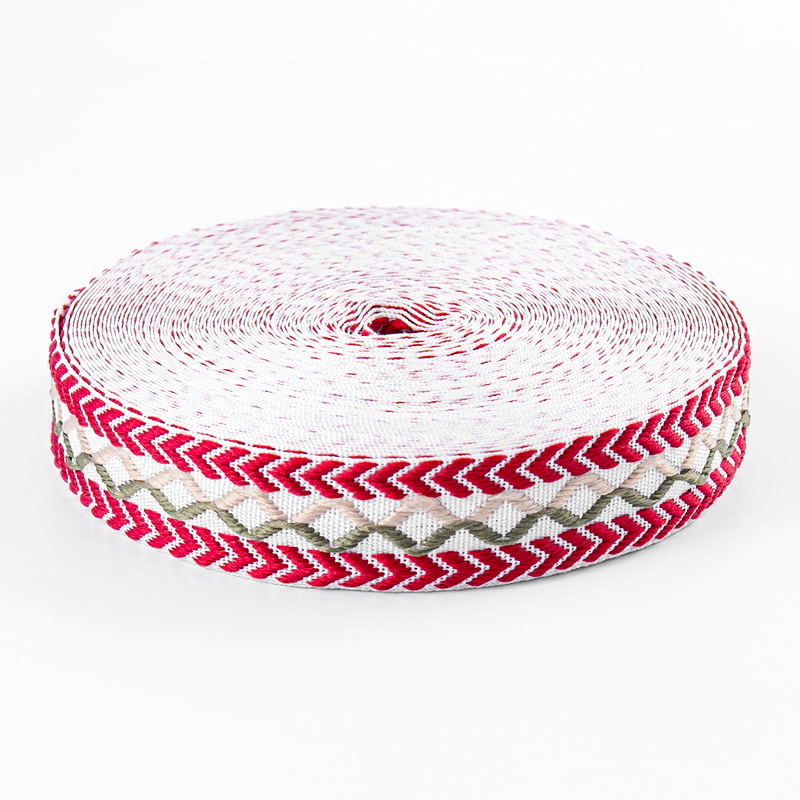
Jacquard webbing is a narrow woven strap whose pattern is produced by the weave itself: colored yarns are interlaced so that logos, lettering, and motifs are built into the fabric instead of applied to it. The technique takes its name from Joseph Marie Jacquard, whose 1804 loom first lifted each warp yarn independently; every modern jacquard loom still runs on that principle.
Core definition
Jacquard webbing: a woven narrow fabric in which each warp yarn is controlled individually during weaving, so logos, text, and multi-color patterns are integrated into the strap structure rather than printed onto its surface.
A plain webbing loom produces solid colors and simple stripes; a jacquard head lifts selected warp ends at each pass, so the pattern repeats precisely along the whole roll. Pattern yarns add body and loom setup takes longer, which is why sampling matters more here than for plain webbing.
| Attribute | Woven jacquard webbing | Printed webbing |
| How the pattern is made | Woven in with colored yarns | Ink bonded to the surface |
| Wear over time | Pattern lasts as long as the strap itself | Ink can crack, fade, or rub off at folds and hardware |
| Reverse side | Pattern visible on both faces | Usually a plain ground color |
| Best fit | Brand straps, pet leads, luggage, furniture trim | Short runs and low-abrasion decoration |
As a working rule, printing suits short promotional runs and low-friction decoration, while woven jacquard webbing pays for itself wherever the strap carries the brand, flexes constantly, or is washed often.
How the Loom Turns Artwork Into a Woven Pattern
Pattern quality is decided on the loom, not in the design file: the fineness of detail is capped by the number of warp ends the jacquard head can control across the strap width.
In production, artwork is digitized into a warp-lift plan: one column per warp end, one row per weft pass. Lifted ends show the pattern color; unlifted ends are carried inside the strap or tied down. That is why repeats stay fixed, why both faces mirror each other, and why thin serif lettering can lose its fine strokes at 25 mm. Four production variables decide how crisp a logo will look:
- Warp density: more ends per centimeter give finer detail and smoother curves
- Yarn fineness: finer yarns sharpen edges but cost more and weave more slowly
- Tie-down ends: they lock long floats to the body so the pattern cannot snag
- Repeat size: the design must divide evenly into the weaving width or it drifts
A quick pre-sample check: scale the artwork to the real strap width on screen. Lettering that stays legible at that size can usually be woven; text that collapses into gray blocks will not improve on any loom.
Polyester, Nylon, or Polypropylene: Choosing the Base Yarn
Polyester is the default base yarn for jacquard webbing: it takes bright dyed colors, resists sunlight, and barely stretches under load, so a woven logo keeps its shape for years.
The numbers behind that default: polyester absorbs about 0.4 percent of its weight in moisture, against roughly 4 percent for nylon. Nylon earns its place where stretch or maximum abrasion resistance matters: high-stretch nylon jacquard serves apparel straps, and standard nylon suits harnesses and heavy leads. Polypropylene is the lightweight, economical option; hollow polypropylene webbing is a staple for camping gear and floats on water.
Match the yarn to the environment first: a sharp logo on a yarn that fades outdoors, sags under load, or wicks water is a failed strap.
| Property | Polyester | Nylon | Polypropylene |
| Water absorption | Very low | Noticeable | Near zero; floats |
| Stretch under load | Low | Moderate; elastic versions exist | Low |
| Sunlight resistance | Very good | Good | Fair in unpigmented grades |
| Typical jacquard uses | Bag straps, pet leads, furniture trim | Stretch straps, harnesses, heavy leads | Camping and outdoor gear trim |
Because polyester and nylon dominate buyer debates, it is worth reading a dedicated polyester vs nylon webbing comparison before locking the specification. For load-bearing choices, the chart below gives indicative tensile strength for general-purpose 25 mm straps by yarn.
Indicative tensile strength by base yarn, 25 mm strap
Nylon18 kN
Polyester15 kN
Polypropylene5 kN
Cotton4 kN
Approximate typical values for general-purpose constructions; breaking strength varies with weave density, width, and finishing.
Matching Width and Construction to the End Use
Choose width from load and hardware first, then let the pattern follow: most applications fall into three width bands, mapped to real products in the webbing product catalog.
Rule of thumb: 1.0-1.5 cm for trims, light leashes, and apparel details; 2.0-2.5 cm for load-bearing bag straps, pet leads, and tie-downs; 4.2-5.0 cm for furniture edging, belts, and packaging.
Bags, luggage, and cargo straps
For handles and shoulder straps, 2.0 cm thickened polyester jacquard balances comfort, sewability, and strength, putting branding exactly where the hand grips. For compression and cargo straps, prioritize tight selvedges and abrasion cover over decorative detail.
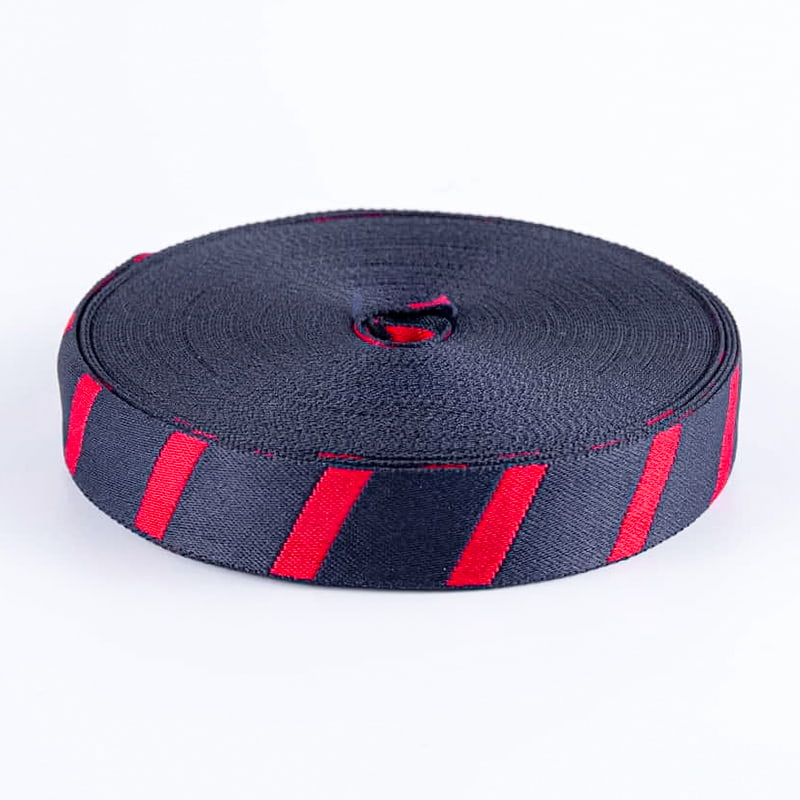 2cm Thickened Polyester Jacquard Webbing for Curtains and LuggageA 2cm thickened polyester jacquard webbing with a clear 3D pattern, good tensile strength, abrasion resistance, and colorfastness. Its durability and refined look suit curtain tapes, luggage details, and other home-textile applications where visible trim must hold up over time.View Product →
Furniture, curtains, and bedding
Home-textile buyers use jacquard webbing where it is seen: 2.5 cm ethnic-style straps trim sofa edges and cushions, mesh overlock constructions reinforce bedding seams, and wider straps serve as curtain tape and hanging loops. On visible edges the reverse face matters nearly as much as the front.
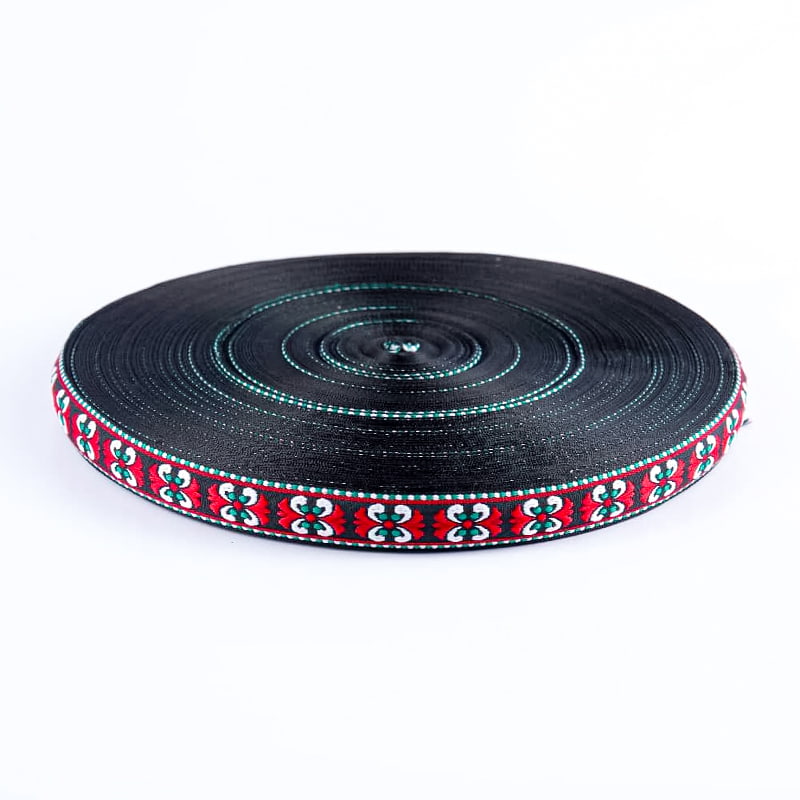 2.5cm Ethnic-Style Jacquard Webbing for Furniture and Apparel TrimThis 2.5cm polyester jacquard webbing features computerized ethnic-style patterns with a smooth, three-dimensional finish and stable color. Ideal for sofa edging, cushions, apparel, and accessories, it works well where decorative trim is visible on both faces.View Product →
Apparel, footwear, and headwear
Garment trims favor lighter builds: 4.2 cm imitation-nylon jacquard gives a firm, nylon-like hand at lower cost for hat bands, shoe detailing, and belt-effect trim, while 1.0 cm reflective and high-density tapes cover safety duties.
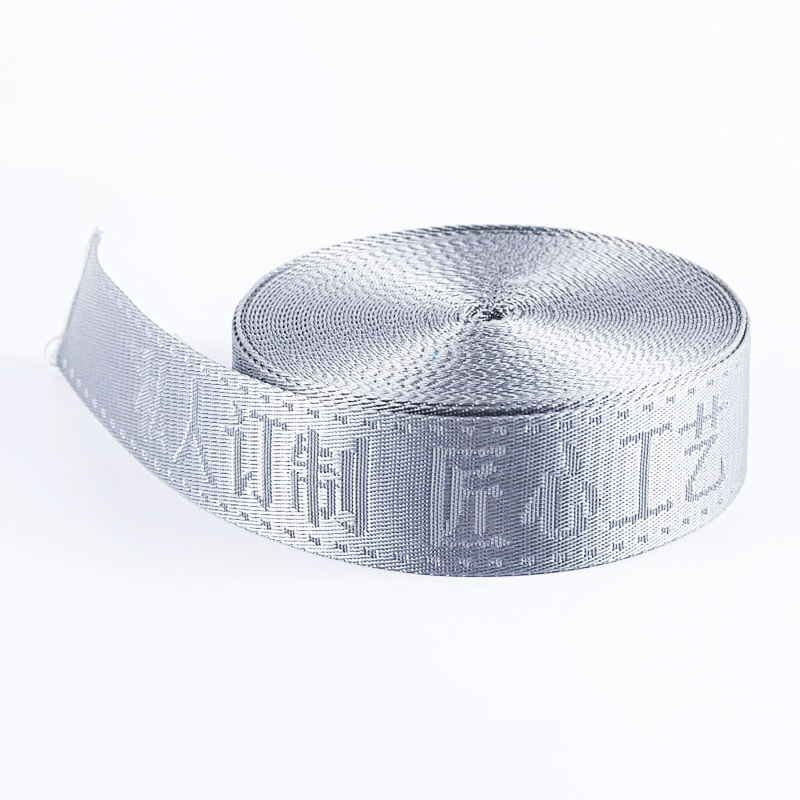 4.2cm Imitation Nylon Jacquard Webbing for Apparel, Shoes, and HatsA 4.2cm imitation nylon jacquard webbing woven on computerized machines, offering a firm nylon-like hand with wear and stretch resistance at lower cost. Suited to hat bands, shoe detailing, belt-effect trim, and luggage decoration on lighter garment builds.View Product →
Ordering Custom Jacquard Webbing: From Sample to Bulk
Custom jacquard webbing moves through five fixed stages; the fastest projects start with a clean vector file or a physical sample.
- Send the brief. Width, thickness, base yarn, application, indicative quantity, plus artwork or a sample to match.
- Digitize the pattern. The mill converts the design into a warp-lift plan and confirms repeat size and achievable colors.
- Approve samples. Judge hand feel, color, edges, and the reverse side against your reference in daylight.
- Run bulk production. Rolls are woven to the approved sample, with width and alignment checked in-process.
- Inspect on arrival. Verify width, color, and repeat before cutting, and seal one sample for re-orders.
1.0-5.0 cmwidth range across jacquard-capable lines
4base yarn families: polyester, nylon, polypropylene, cotton
12 hweekday response window for buyer inquiries
Minimums and lead times vary by construction, so treat them as questions, not assumptions. Sample-based development is standard practice at Haining Fengrun Rope Weaving Co., Ltd., a webbing factory in Haining, Zhejiang that weaves jacquard, nylon, polyester, and polypropylene straps and builds orders directly from customer samples.
Five Checks Before You Approve a Bulk Run
Approve bulk jacquard webbing only after checking what the finished product will expose: color, geometry, and weave tightness.
- Color match against the approved sample in daylight, not under shop lighting
- Repeat alignment along the full roll: the pattern must not drift toward one selvedge
- Width consistency at several points per roll, measured against the nominal specification
- Reverse side: tie-back yarns lying flat, with no loops that can catch hardware
- Weave tightness: bend a short length sharply and confirm that no pattern yarn slips
Ask for the weave specification with every sample: yarn type, ends per centimeter, thickness, weight per meter. That sheet becomes the reference for every re-order and the fastest way to settle disputes.
Jacquard Webbing: Frequently Asked Questions
Is jacquard webbing stronger than printed webbing?
Base strength comes from yarn and weave density, not from the patterning method; a jacquard strap and a printed strap of equal yarn, width, and thickness test similarly. The jacquard advantage is that the pattern cannot wear off.
What widths are standard for jacquard webbing?
Production lines commonly cover 1.0 to 5.0 cm. Pet and bag applications cluster between 1.0 and 2.5 cm, while furniture trim, belts, and packaging webbing run at 4.2 to 5.0 cm.
What does a mill need to quote a custom order?
Four inputs: target width and thickness, base yarn, artwork or a physical sample, and an indicative quantity. With those, a mill can confirm feasibility, repeat size, and pricing before weaving a sample.
Can jacquard webbing carry a customer's own logo?
Yes. Logo webbing is the most common custom request: the artwork is digitized into a warp-lift plan and sampled first, so the buyer approves a physical strap before bulk production is scheduled.
Send width, base yarn, and artwork, and ask for a loom-ready pattern proof before any bulk yarn is committed; it is the cheapest insurance in the entire process.