English
  中文简体
中文简体 We are a national high-tech enterprise. At present, there are many kinds of self-woven and cooperatively processed fabrics, including microfiber warp-knitted towel cloth, weft-knitted towel cloth, coral fleece, etc.
Content
- 1 Materials used for jacquard webbing: a comparative analysis
- 2 Jacquard webbing breaking strength parameters: what the numbers mean
- 3 How jacquard weaving affects strength and performance
- 4 Practical selection guide: matching webbing to application
- 5 Breaking strength test data: real-world examples
- 6 Quality control and certification for polyester webbing
- 7 Finishing treatments that affect strength
Direct conclusion: Polyester webbing straps offer the best combination of strength, dimensional stability, and cost-effectiveness for demanding applications. For jacquard webbing, the breaking strength typically ranges from 300 kg to 5000 kg depending on width, construction, and yarn denier, with polyester providing 20-30% higher tensile strength than nylon of equivalent size. The material choice directly determines performance: 100% polyester delivers superior UV resistance and low elongation (less than 5% at working load), while blended constructions (polyester/cotton or polyester/nylon) offer specific aesthetic or tactile benefits at the cost of some strength. When selecting jacquard webbing, always match the breaking strength to the end-use safety factor, and verify that the webbing meets relevant standards such as ASTM D6775 or EN 1492-1 for lifting applications.
Critical insight: The breaking strength of jacquard webbing is not determined solely by material type. The weave density, yarn twist, and finishing process (heat-setting, coating) can alter the final tensile performance by up to 40%. Always request certified test reports from your supplier, and perform incoming quality checks on every batch.
Materials used for jacquard webbing: a comparative analysis
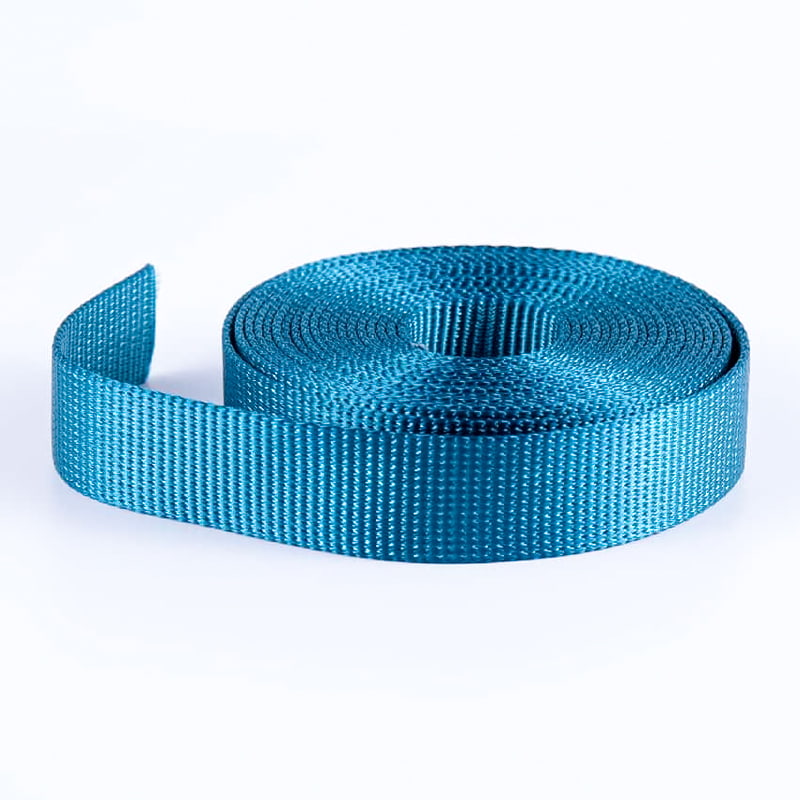
The selection of raw materials for polyester webbing straps involves balancing mechanical properties, environmental resistance, and decorative possibilities. Below is a practical breakdown of the most common materials:
| Material type | Breaking strength (relative) | UV resistance | Abrasion resistance | Typical applications |
|---|---|---|---|---|
| 100% Polyester (high-tenacity) | 1.0 (baseline) | Excellent (90% retention after 500h) | Very good | Safety harnesses, cargo lashings, outdoor gear |
| 100% Nylon (type 66) | 1.1 – 1.2 | Poor (fades & weakens quickly) | Excellent | Load restraint, tow straps (indoor or short-term use) |
| Polyester / Cotton blend (70/30) | 0.6 – 0.7 | Moderate | Moderate | Fashion belts, luggage trim, decorative webbing |
| Polyester / Nylon blend (50/50) | 0.9 – 1.0 | Moderate | Good | Military webbing, tactical gear |
| PP (Polypropylene) – for comparison | 0.5 – 0.6 | Poor | Poor | Light-duty packaging, disposable straps |
High-tenacity polyester (PET) yarn with a tenacity of 8.0–9.5 g/denier is the preferred choice for jacquard webbing. The jacquard weaving process itself does not reduce the intrinsic fiber strength, but the pattern density and float lengths can create stress concentrations. For patterned webbing with complex designs (e.g., logos, multi-color stripes), the effective breaking strength may be 8-12% lower than plain webbing of the same width, due to yarn displacement and additional abrasion during weaving.
Jacquard webbing breaking strength parameters: what the numbers mean
Breaking strength is the single most critical performance metric for safety-critical applications. The key parameters to understand are:
- Minimum breaking strength (MBS): The absolute load at which the webbing fails under controlled laboratory conditions (typically tested on a universal tensile machine at 100 mm/min grip separation). For polyester jacquard webbing, standard MBS values are:
- 25mm width: 450 – 600 kg (typically used for dog collars, camera straps)
- 38mm width: 900 – 1200 kg (tactical belts, rescue harnesses)
- 50mm width: 1500 – 2000 kg (industrial lifting, fall protection)
- 75mm width: 2500 – 3500 kg (heavy cargo, tie-downs for shipping)
- 100mm width: 4000 – 5000 kg (marine towing, structural slings)
- Working load limit (WLL): The maximum safe working load, usually calculated as MBS divided by a safety factor (typically 5:1 for lifting, 7:1 for personnel protection). For a 50mm polyester webbing with MBS of 2000 kg, the WLL would be 400 kg for general lifting.
- Elongation at break: Polyester webbing stretches 8-14% at failure, compared to 20-30% for nylon. This low stretch is desirable for applications requiring precise positioning and minimal dynamic loading.
Industry standard: ASTM D6775 is the most widely referenced test method for webbing strength. It requires a minimum of 5 specimens per batch, conditioned at 21°C and 65% relative humidity for 24 hours. The reported breaking strength must be the average of all tests, with no individual value falling below 90% of the average.
How jacquard weaving affects strength and performance
The jacquard mechanism, which controls individual warp yarns to create patterns, introduces specific considerations for strength parameters:
- Pattern density and yarn float: In areas with long floats (where warp yarns skip over several weft picks), the webbing becomes slightly looser, reducing the load-bearing cross-section. A complex floral design with 30% float area may lose 8-10% breaking strength compared to a solid weave.
- Edge finish: The selvedge (edge) of jacquard webbing is critical. Hemmed edges (where the warp yarns are folded back) increase edge strength and prevent unraveling. Untreated edges can reduce the effective breaking strength by up to 15% because the outermost yarns carry a disproportionate share of the load.
- Color and dyeing process: Piece-dyed webbing (colored after weaving) typically retains 95% of its base strength. Yarn-dyed webbing, where the polyester yarns are colored before weaving, may have slightly lower strength (by 2-3%) due to the dyeing thermal cycle, but offers better colorfastness and pattern clarity.
Practical selection guide: matching webbing to application
Choosing the right polyester webbing straps requires a systematic evaluation of the operating environment. Use the following decision criteria:
- Determine the required working load: Multiply the maximum expected load by the appropriate safety factor. For recreational use (belts, bags), a factor of 3:1 is acceptable. For industrial lifting, use 5:1. For fall protection, use 10:1.
- Assess environmental exposure: If the webbing will be used outdoors for extended periods, polyester is mandatory due to its UV resistance (nylon degrades rapidly under sunlight). For applications involving chemical contact (oils, fuels, acids), polyester also outperforms nylon, which absorbs moisture and loses strength when wet.
- Consider abrasion and bending fatigue: Jacquard webbing with a tighter weave and higher picks per inch (PPI) resists edge fraying and surface wear. For high-abrasion applications (e.g., automotive seat belts, industrial slings), specify a coating or a denser weft density of 32-36 PPI.
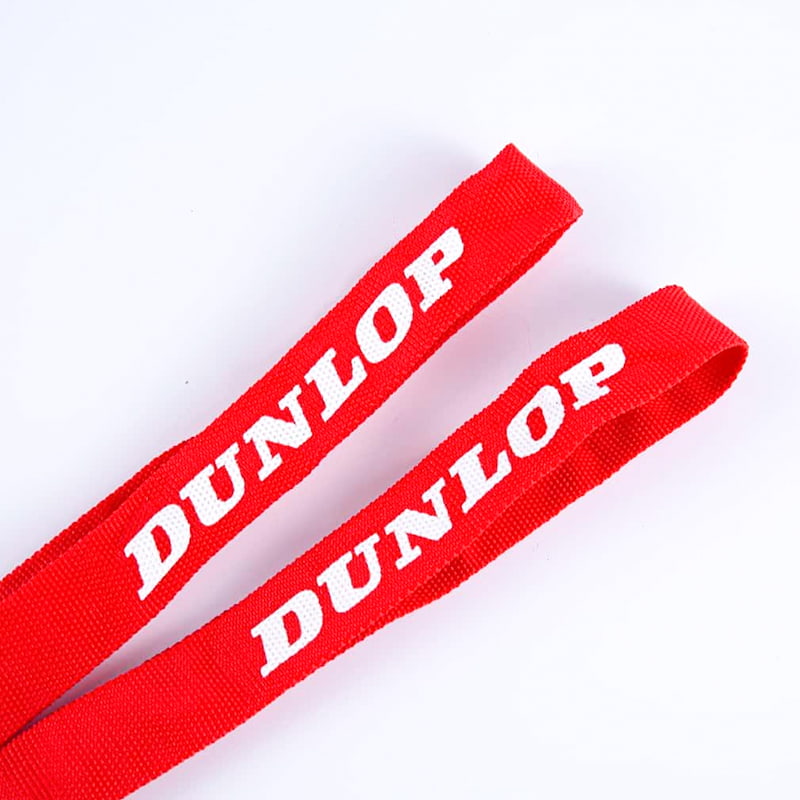
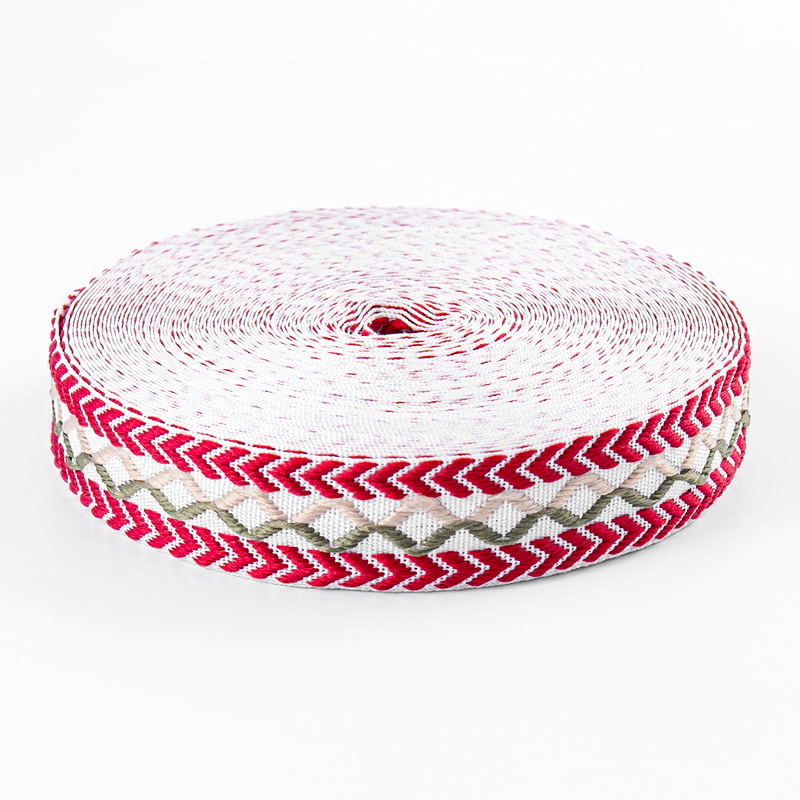
- Visual and branding requirements: The jacquard process allows infinite patterns, logos, and text to be woven directly into the webbing. However, complex patterns require more weaving time and may increase cost by 20-50% compared to plain webbing.
Breaking strength test data: real-world examples
The following table provides actual test results from a certified laboratory for common polyester jacquard webbing specifications:
| Width (mm) | Construction (ends x picks) | Breaking strength (kg) | Elongation at break (%) | Typical WLL (kg) (5:1 factor) |
|---|---|---|---|---|
| 25 | 120 x 44 | 520 | 11.2 | 104 |
| 38 | 180 x 48 | 1,050 | 10.5 | 210 |
| 50 | 240 x 52 | 1,850 | 9.8 | 370 |
| 75 | 360 x 56 | 3,200 | 8.9 | 640 |
| 100 | 480 x 60 | 4,800 | 8.2 | 960 |
Note: These values represent standard commercial grades (polyester HT yarn, 1100 dtex). Custom webbing with increased yarn count or special coatings can achieve 15-20% higher breaking strengths. Always request a material certificate with each shipment, and cross-check the reported MBS against your design requirements.
Quality control and certification for polyester webbing
To ensure consistency and safety, reputable manufacturers implement a multi-stage quality control process:
- Yarn incoming inspection: Each batch of polyester yarn is tested for denier, tenacity, and elongation uniformity. Yarn with a coefficient of variation (CV) above 3% is rejected, as it leads to strength variations in the finished webbing.
- In-process checks: During weaving, the tension is monitored continuously. Variations in warp tension cause the webbing to curl or become "soft spots" that reduce breaking strength by up to 20%. Modern jacquard looms with electronic warp let-off maintain tension within +/- 1% of the set value.
- Final testing: At the end of the production run, samples from each roll are subjected to breaking strength tests, width measurement, and visual inspection for defects (e.g., dropped picks, float errors). The acceptance criterion is that every roll meets the specified MBS, with a tolerance of -5% for non-critical applications and 0% for safety-critical applications.
Compliance reminder: For webbing used in personal protective equipment (PPE) or lifting gear, the product must carry CE marking (Europe) or comply with OSHA regulations (USA). The manufacturer must have a certified ISO 9001 quality management system in place, and the webbing should be traceable back to the specific yarn batch and production date.
Finishing treatments that affect strength
Post-weaving treatments can significantly modify the performance of polyester jacquard webbing:
- Heat-setting: This process stabilizes the webbing dimensions and reduces shrinkage to less than 2% in subsequent wash cycles. Heat-setting at 180-200°C does not materially reduce breaking strength, provided the dwell time is kept under 60 seconds.
- Water-repellent coating: Fluoropolymer or silicone coatings add water resistance but may reduce the breaking strength by 3-5% due to the stiffness introduced into the yarns.
- Anti-slip coating (e.g., neoprene or PVC dots): Used on webbing for cargo straps, this coating adds friction but does not affect the tensile strength of the base webbing.
- Fire-retardant treatment: FR finishes are mandatory for webbing used in aviation, marine, and public transport. Depending on the chemical additive, FR treatment may reduce the breaking strength by up to 10%. Test samples should be conditioned and tested after the finishing process.
Final recommendation: When specifying polyester webbing straps for any application that involves human safety or valuable cargo, over-specify the breaking strength by at least 25% above the calculated requirement. This margin accounts for variations in weaving quality, environmental degradation over time, and unforeseen dynamic loads. Always obtain test data from an accredited lab, and perform periodic retesting on stored webbing that exceeds 5 years of age, as polyester can experience gradual strength loss in harsh storage conditions.